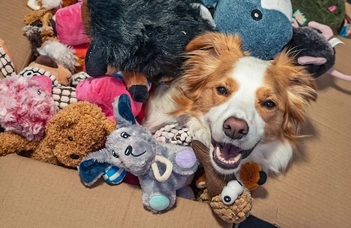
Why can some dogs learn a vocabulary of hundreds of object names?
Our research is discovering the answer!
Most dogs can learn action cues like “sit” or “down.” But our work has revealed something remarkable: a very small subset of dogs can go much further.
These uniquely Gifted Word Learner (GWL) dogs learn the names of dozens—even hundreds—of object names
such as “frisbee”, “rope” and “Teddy bear” forming vast vocabulaires of object verbal labels.
We discovered that GWL dogs acquire new object names at an astonishing pace. They do this naturally, during everyday play with their owners. No intentional training needed. They not only retain these names for long periods but also extend the labels to categorize their toys, offering a rare window into canine cognition.
Our research explores three central questions:
- What makes GWL dogs different from other dogs?
- How do they learn object names, and how does this process compare to early word learning in human infants?
- How does learning words shape the way dogs mentally represent their world?
Through this work, we aim to better understand the extraordinary abilities of these dogs—and what they can teach us about language, learning, cognition, and the human–animal bond.
Ready to be surprised? Watch what we found so far
Watch more videos below in our gallery.
Our research team
Our group is led by Dr. Claudia Fugazza and Prof. Adam Miklosi and includes Fumi Higaki (PhD student), Andreea Nastase (PhD student), Marina Smagina (visiting PhD student), Dr. Shany Dror (volunteer helper), Agnes Renata Markus (MsC student).
Dr. Claudia Fugazza, geniusdogchallenge.official@gmail.com WhatsApp +393382064951
To see what’s new, follow us on our social media: https://linktr.ee/geniusdogchallenge
Does your dog know his toys by name? Apply to participate in our research!
If your dog knows the names of more than 10 objects or toys, please send us a video along with the information listed below to: geniusdogchallenge.official@gmail.com
- Your name and country
- Your dog’s name, breed, sex and age
- Number of toy names your dog knows
- Please include the following consent statement in your email:
I agree to the use of my information for research purpose and consent to being contacted.
How to submit your video:
Please record the video following the guidelines below. Also see the video instruction here
Place all the toys your dog knows on the floor (If your dog knows more than 10 toys, choose any 10 and place those on the floor).
- Set the camera at a low angle so that both the toys and the entrance to the room are visible. If you are using a mobile phone, please record the video horizontally.
- Step outside the room. From a position where you can not see the toys, ask your dog to bring the toy one by one.
- Do not start by asking for the dog’s favorite toy. Instead, ask for the toys in a random order.
- When there are only 7 toys left on the floor, please return the previously requested toys (or other toys your dog knows by name) so there are 10 toys on the floor again. Then continue with the remaining items on your list. If you have less than 7 toys, please bring the toys back after every trial.
- You do not need to record your dog retrieving all the toys. Showing 5 or 6 successful retrievals is sufficient.
- Please do not edit the video.
- It is not necessary for the owner to appear in the video, but please make sure that the toy names can be clearly heard. You may use a second camera to film yourself outside the room, but this is not required.
Our Publications
Publications:
- Fugazza C., Sommese A., Miklosi A. (2025) Dogs extend verbal labels for functional classification of objects. Current Biology 35, 1-7
- Higaki F., Faragó T., Pogány Á., Miklosi A., Fugazza C. (2025) Sound quality impacts dogs’ ability to recognize and respond to playback words. Scientific Reports 15, 14175. https://doi.org/10.1038/s41598-025-96824-8
- Fugazza C., Jacques E., Nostri S., Kranzelic U., Sommese A., Miklosi A. (2024) Shape and texture biases in dogs’ generalization of trained objects. Scientific Reports 14, 28077, https://doi.org/10.1038/s41598-024-72244-y
- Dror S., Miklosi A., Fugazza C. (2024) Dogs with a vocabulary of object labels retain them for at least 2 years. Biology Letters https://doi.org/10.1098/rsbl.2024.0208
- Dror S., Miklósi Á., Sommese A., Fugazza C. (2023) A citizen science model turns anecdotes into evidence by revealing similar characteristics among Gifted Word Learner dogs. Scientific Reports 13:21747 https://doi.org/10.1038/s41598-023-47864-5
- Fugazza C., Temesi A., Uccheddu S., Coronas R., Pogány A. (2023) Spontaneous action matching in dog puppies, kittens and wolf pups. Scientific Reports. DOI 10.1038/s41598-023-28959-5
- Fugazza C., Turcsan B., Sommese A., Dror S., Temesi A., Miklósi A. (2022) A comparison of personality traits of gifted word learner and typical border collies. Animal Cognition https://doi.org/10.1007/s10071-022-01657-x
- Dror S., Sommese A., Miklósi A., Temesi A., Fugazza C., (2022) Multisensory mental representation of objects in typical and Gifted Word Learner dogs. Animal Cogntion https://doi.org/10.1007/s10071-022-01639-z
- Sommese A., Miklósi Á., Pogány Á., Temesi A., Dror S., Fugazza C. (2021) An exploratory analysis of head‐tilting in dogs Animal Cognition DOI: 10.1007/s10071-021-01571-8
- Dror S., Miklósi Á., Sommese A., Temesi A., Fugazza C. (2021) Acquisition and long- term memory of object names in a sample of Gifted Word Learner dogs. R. Soc. Open Sci. 8: 210976. DOI: 10.1098/rsos.210976
- Fugazza C., Dror S., Sommese A., Temesi A., Miklósi A. (2021) Word learning dogs (Canis familiaris) provide an animal model for studying exceptional performance. Scientific Reports 11:14079
- Fugazza C., Andics A., Magyari L., Dror S., Zempléni A., Miklósi A. (2021) Rapid learning of object names in dogs. Scientific Reports, 11:2222 https://doi.org/10.1038/s41598-021-81699-2
- Fugazza, C., Miklósi, A. (2020): How to make smoke without fire. Minds are not (just) trainable machines. Learning & Behavior, doi : 10.3758/s13420-020-00447-0
- Fugazza, C., Miklósi, A. (2020): Depths and limits of spontaneous categorization in a family dog. Scientific Reports, DOI: 10.1038/s41598-020-59965-6
Video Gallery of Genius Dog Challenge
Video abstract for the study: Fugazza, C., Jacques, E., Nostri, S. et al. Shape and texture biases in dogs’ generalization of trained objects. Sci Rep 14, 28077 (2024). https://doi.org/10.1038/s41598-024-72...
0
/
0
0
/
0